
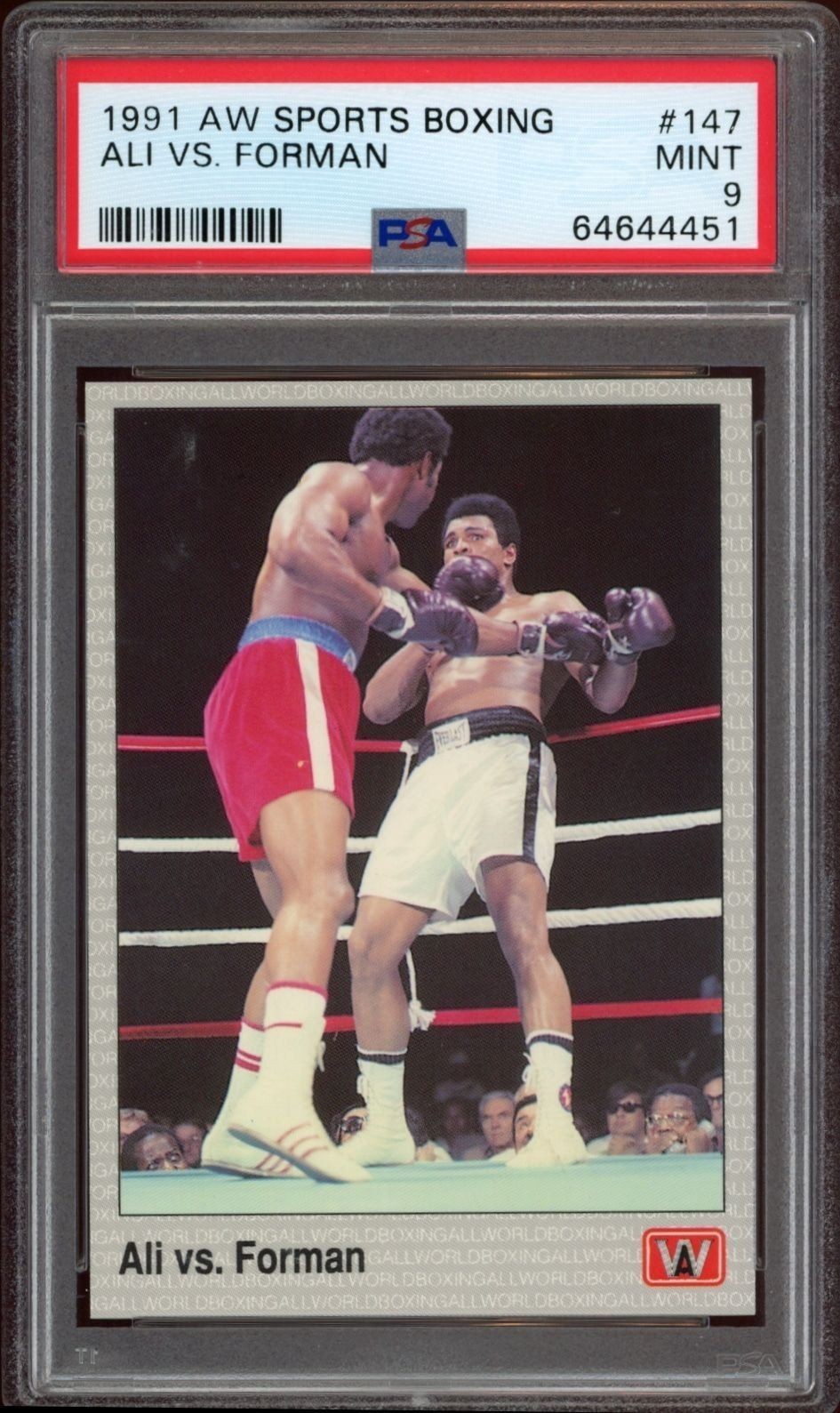


The 1991 AW Sports Boxing George Foreman #16 trading card features legendary heavyweight champion George Foreman. This vintage boxing card is a staple for collectors of retro sports memorabilia.
| Condition | Value | Source | Trend | Price Details |
|---|---|---|---|---|
$3.05 | Guide Estimate | |||
$14.14 | Guide Estimate | |||
$30.34 | Guide Estimate | |||
$53.71 | Guide Estimate | |||
$202.00 | Guide Estimate | |||
$93.00 | Guide Estimate | |||
$155.07 | Guide Estimate | |||
$93.00 | Guide Estimate | |||
Raw / Ungraded
PriceCharting Price Guide · Guide Estimate evidence · captured Sep 29, 2026
History is building. At least two days of matching observations are needed to show a trend.
Each point is the last stored observation that day for this printing, condition, grader, autograph status and source. Gaps mean no observation; guide estimates and asking prices are not completed sales.The 1991 AW Sports Boxing George Foreman #16 trading card captures the enduring legacy of one of boxing's most formidable heavyweights. Released during a vibrant era for sports collectibles, this card from the AW Sports series offers a tangible connection to the golden age of boxing fandom. George Foreman remains an iconic figure in the sport, known for his powerful punching ability and charismatic personality that transcended the ring. Collectors of vintage boxing cards often seek out items from the early 1990s, a period that saw a resurgence in trading card production across various sports categories. The 1991 AW Sports set provides a specific snapshot of this time, documenting athletes who defined their respective divisions. For those building a comprehensive collection of boxing history, the George Foreman #16 card serves as a fundamental component, bridging the gap between active competition and post-career legend status. The appeal of this card lies in its simplicity and historical context. Unlike modern releases that often rely on complex parallels or embedded memorabilia, vintage cards like this one are valued for their direct representation of the athlete during a specific year. Enthusiasts of 1991 sports memorabilia appreciate the aesthetic and production styles of that period, making this George Foreman card a desirable addition to any focused boxing collection. Whether you are a lifelong fan of Foreman’s career or a generalist collector of sports history, this card represents a solid piece of boxing heritage.
1 day ago
We'll pre-fill the product details from this catalog entry, so your listing lands on this exact page. Just add photos of your copy, pick its condition, and set your price.
The catalog profile below summarizes the card identity, featured subject, and notable collectible traits.
The core identity of the card within the set.
The subject, team, league, and sport context tied to this card.
Production details and format-specific attributes.
Material
Card Stock
Language
English
See how many public collections currently include this card.
0 collectors have this card
The 1991 AW Sports George Foreman card occupies a niche tier within early-90s boxing card sets, drawing interest primarily from Foreman collectors who recognize this era as coinciding with his legendary comeback — a period that ultimately led to his 1994 heavyweight championship recapture at age 45. With only a single active listing available, the card commands a scarcity-driven premium rather than broad market liquidity, meaning price discovery is largely seller-controlled. Compared to mainstream boxing card brands of the same era, AW Sports issues generally trade at modest levels, though Foreman's crossover appeal as a cultural icon elevates demand beyond typical boxing card benchmarks.
AW Sports was a limited regional or specialty producer in the early 1990s, resulting in naturally constrained print runs that were never formally documented — making population data sparse and raw copies difficult to authenticate with confidence. Graded copies represent a very small universe, and any PSA or BGS-certified example would likely rank among the few formally encapsulated specimens in existence, giving graded copies a meaningful edge over raw counterparts. This appears to be a base card rather than a parallel or insert, but the low production origin of the set itself functions as an inherent rarity factor.
George Foreman's Hall of Fame status, two-time heavyweight championship legacy, and enduring mainstream recognition through the George Foreman Grill create sustained collector demand that extends well beyond traditional boxing card audiences. The extreme scarcity of active listings and low graded population suggest this card has not yet been widely targeted for grading submissions, meaning early movers who pursue professional grading could benefit from a low-competition population report. As vintage boxing cards from underrepresented brands gain traction among registry collectors and type collectors, this AW Sports issue carries long-term upside contingent on broader market awareness.