



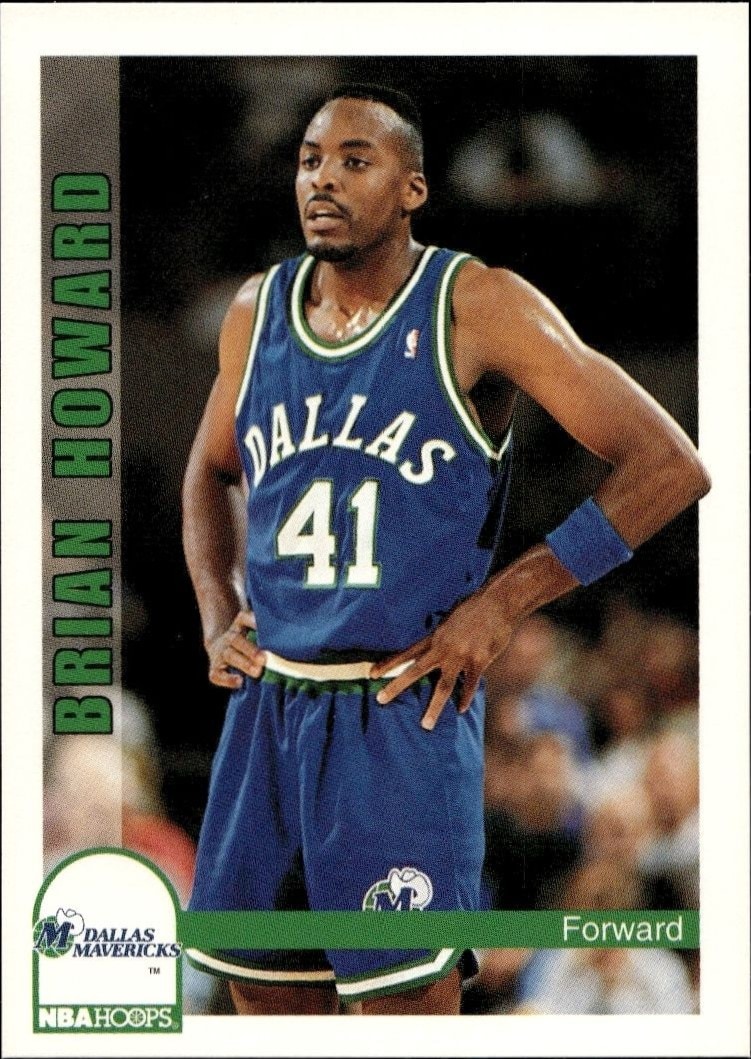
Explore the 1992-93 Fleer Brian Howard #323 basketball card, a staple of early 90s NBA collectibles featuring the Dallas Mavericks guard.
1992-93 • Fleer
National Basketball Association • Dallas Mavericks
Excellent
323
New
Shipping Calculated at Checkout
This seller is away until 10/19/2026 — orders are still accepted and ship after they return.30-day Returns| Condition | Value | Source | Trend | Price Details |
|---|---|---|---|---|
$0.82As of 9/25/2026 | Guide Estimate | |||
$1.99As of 4/16/2026 | Evidence Type Unavailable | |||
Raw / Ungraded
PriceCharting Price Guide · Guide Estimate evidence · captured Sep 25, 2026
History is building. At least two days of matching observations are needed to show a trend.
Each point is the last stored observation that day for this printing, condition, grader, autograph status and source. Gaps mean no observation; guide estimates and asking prices are not completed sales.The 1992-93 Fleer Brian Howard #323 basketball card represents a definitive entry in the golden era of NBA trading cards. Released during a pivotal time for the sport, this card features Brian Howard in his Dallas Mavericks uniform, capturing the visual style that defined Fleer's design philosophy in the early 1990s. For collectors of vintage basketball memorabilia, cards from this year offer a tangible connection to the league's expanding global popularity. Brian Howard's tenure with the Mavericks is well-documented within the context of this release. Card #323 serves as a primary identifier for fans and investors looking to build comprehensive sets of 1992-93 Fleer basketball cards. The card's layout and typography reflect the bold, graphic-heavy aesthetic that made Fleer a dominant force in the market during this period. Whether you are a dedicated set builder or a hobbyist interested in the history of the Dallas Mavericks, this card provides essential catalog value. Vintage basketball cards from the 1992-93 season continue to hold significant interest among enthusiasts who appreciate the raw, unpolished charm of pre-digital era designs. The 1992-93 Fleer Brian Howard #323 card remains a recognizable piece of NBA history, offering a glimpse into the roster dynamics of a team in transition. Collectors often seek out these cards to complete their library of 90s basketball products, valuing them for their historical accuracy and design integrity. As part of the broader Fleer brand legacy, this card stands as a testament to a vibrant time in sports card collecting.
1 hour ago
We'll pre-fill the product details from this catalog entry, so your listing lands on this exact page. Just add photos of your copy, pick its condition, and set your price.
The catalog profile below summarizes the card identity, featured subject, and notable collectible traits.
The subject, team, league, and sport context tied to this card.
Production details and format-specific attributes.
Material
Card Stock
Language
English
Compare prices, grades, photos, and shipping from approved sellers.
New
Excellent
See how many public collections currently include this card.
0 collectors have this card
This entry trades at the lowest tier of the 1992-93 Fleer set, reflecting its status as a common base card featuring a role player rather than a franchise icon. While Brian Howard had a defined career with the Dallas Mavericks, the lack of special attributes keeps this item firmly in the bulk-category pricing range. It serves primarily as a fill-in for basic collection completion rather than a standalone investment vehicle.
The card carries no scarcity mechanics such as serial numbering, short-print status, or parallel finishes, meaning it represents the full print run of the base set. Supply is effectively unlimited relative to collector demand, as these were mass-produced without any artificial constraints on availability. Consequently, the item lacks the supply-side drivers that typically support value retention or appreciation in secondary markets.
As a non-rookie, base-level card from a standard basketball set, this item lacks the premium mechanics associated with rookie cards or limited-edition parallels. Collector demand is driven solely by the need to complete specific set slots, which limits liquidity and price growth potential. It is best viewed as a low-cost acquisition for completing a broader collection rather than a standalone asset for portfolio growth.