



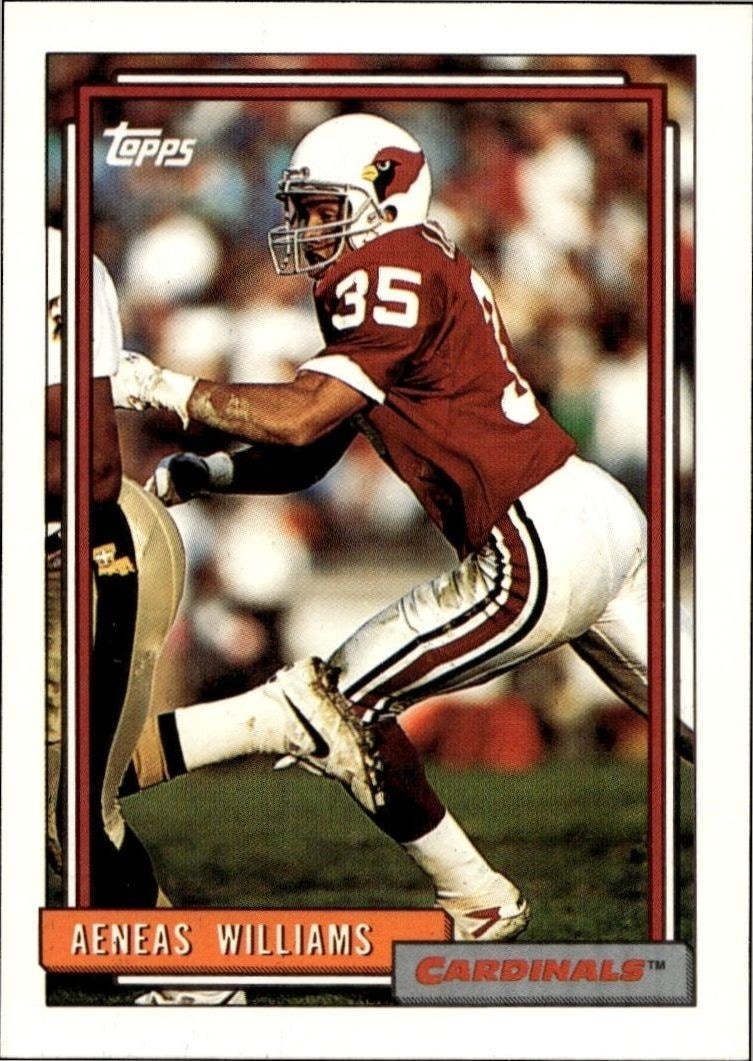
The 1991 Upper Deck Aeneas Williams #630 football card features the Phoenix Cardinals defensive back in this iconic vintage release.
1991 • Upper Deck
National Football League • Phoenix Cardinals
Near Mint
630
New
Shipping Calculated at Checkout
Arrives in 5-7 daysEstimated delivery October 29, 2026 - October 31, 2026
30-day Returns| Condition | Value | Source | Trend | Price Details |
|---|---|---|---|---|
$1.19 | Guide Estimate | -20.1% | ||
$17.79 | Guide Estimate | 0% | ||
$20.00 | Guide Estimate | 0% | ||
$30.00 | Guide Estimate | 0% | ||
$40.00 | Guide Estimate | 0% | ||
$12.00 | Guide Estimate | -36.8% | ||
$31.00 | Guide Estimate | 0% | ||
$19.00 | Guide Estimate | 0% | ||
Raw / Ungraded
PriceCharting Price Guide · Guide Estimate evidence · captured Oct 24, 2026
The 1991 Upper Deck release remains a cornerstone for vintage football collectors, and the Aeneas Williams #630 card is a notable component of this series. As a defensive back for the Phoenix Cardinals during the early 1990s, Williams appeared on this checklist, offering collectors a tangible connection to the NFL's gridiron history. Upper Deck's entry into the market that year introduced a new standard for card design, moving away from the glossy finishes of previous decades to a cleaner, more modern aesthetic that defined the era's collecting landscape. For enthusiasts building a complete 1991 Upper Deck set, the Aeneas Williams #630 card serves as an essential target. The checklist included numerous future Hall of Famers and standout rookies, making every card in the base set relevant to serious investors and hobbyists alike. This product represents the standard base version of the card, distinguishing it from parallel variations or insert subsets that may circulate within the same release. Collecting vintage football cards requires attention to detail and an appreciation for the specific teams and players represented in each year's product. The Phoenix Cardinals era holds a unique place in NFL history, and cards featuring players from that franchise provide valuable context for the league's evolution. Whether you are a long-time fan of Aeneas Williams or simply aiming to complete a foundational set from 1991, this card offers a direct link to that period. By prioritizing authentic products and clear categorization, the platform supports both casual hobbyists and professional investors in navigating the complex world of sports memorabilia. Exploring the 1991 Upper Deck set reveals the depth of talent that passed through the league during this pivotal decade, making each card a piece of sporting history.
3 days ago
We'll pre-fill the product details from this catalog entry, so your listing lands on this exact page. Just add photos of your copy, pick its condition, and set your price.
The catalog profile below summarizes the card identity, featured subject, and notable collectible traits.
The subject, team, league, and sport context tied to this card.
Production details and format-specific attributes.
Material
Card Stock
Language
English
Compare prices, grades, photos, and shipping from approved sellers.
New
Near Mint
See how many public collections currently include this card.
0 collectors have this card
This 1991 Upper Deck Aeneas Williams card represents an entry-level tier within the football collectible market, reflecting its status as a non-premium base card from a major set. While Aeneas Williams established himself as a key defensive leader for the Phoenix Cardinals during this era, the lack of special attributes keeps this specific item trading at a modest value relative to his more sought-after rookie or parallel variants. It serves as an accessible acquisition point for collectors focusing on specific team history rather than high-end investment pieces.
The card carries no scarcity mechanics such as serial numbering, short printing, or parallel finishes, meaning it exists as a standard base issue from the 1991 Upper Deck football set. This lack of limited edition features implies a significantly higher supply compared to serial-numbered or autographed versions of the same player. Consequently, the supply is determined solely by the original production volume of the base set, which typically remains abundant for common players in mainstream brands.
As a standard base card from 1991, this item lacks the rookie-card premium that typically drives long-term value appreciation for players of Williams' caliber. Collector demand is likely limited to those seeking to complete specific team or set subsets rather than investors looking for growth potential. Without special attributes to constrain supply or enhance desirability, the card is better suited for casual collection purposes than for significant capital appreciation.