



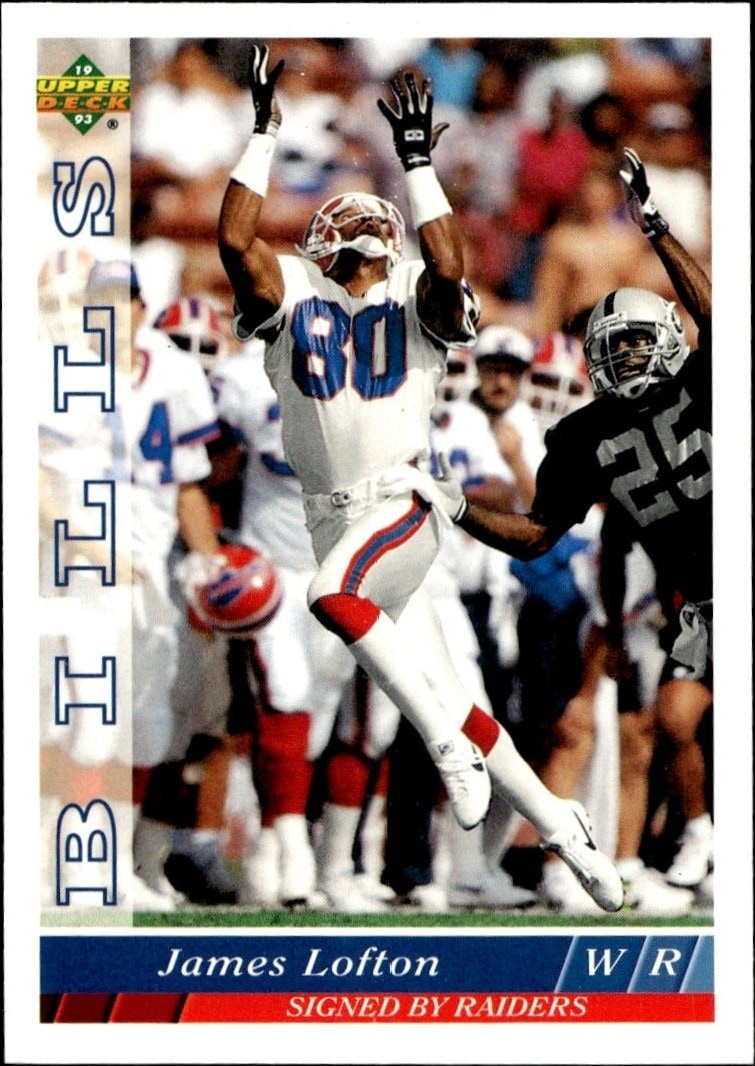
Explore the 1991 Upper Deck James Lofton #358 football trading card, a classic piece of NFL memorabilia from the Buffalo Bills' storied era.
1991 • Upper Deck
National Football League • Buffalo Bills
Excellent
358
New
Shipping Calculated at Checkout
Arrives in 5-7 daysEstimated delivery October 23, 2026 - October 25, 2026
Seller returns October 19, 2026.30-day Returns| Condition | Value | Source | Trend | Price Details |
|---|---|---|---|---|
$1.20 | Guide Estimate | -11.1% | ||
$0.78 | Guide Estimate | 0% | ||
$52.00 | Guide Estimate | 0% | ||
$24.00 | Guide Estimate | 0% | ||
$39.99 | Guide Estimate | 0% | ||
$24.00 | Guide Estimate | 0% | ||
Raw / Ungraded
PriceCharting Price Guide · Guide Estimate evidence · captured Oct 14, 2026
The 1991 Upper Deck James Lofton #358 football trading card captures a defining era of the National Football League, featuring the Buffalo Bills wide receiver during the early 1990s. This issue from the Upper Deck brand is a staple for enthusiasts of vintage sports memorabilia, offering a tangible connection to one of the league's most dynamic offensive players. James Lofton’s career trajectory and his time with the Bills make this card a significant item for those tracking the history of the franchise and the sport itself. Collectors often seek out cards from the early 1990s due to the distinct production styles and the nostalgic value associated with that period. Within this set, the James Lofton #358 card stands out as a key component for builders focusing on NFL players or specifically on the Buffalo Bills' roster from that time. Its presence in a collection adds depth to sets dedicated to 1990s football history. Investing in vintage sports cards like this one allows collectors to preserve a piece of athletic history. The enduring appeal of James Lofton, a Pro Football Hall of Famer, ensures that his cards remain popular among hobbyists. Whether you are completing a set of 1991 Upper Deck cards or assembling a collection of Buffalo Bills legends, this card offers a reliable and recognizable addition. By focusing on the catalog identity of this product, collectors can evaluate its place in the broader market of 1990s sports memorabilia without the distraction of individual listing conditions.
8 hours ago
We'll pre-fill the product details from this catalog entry, so your listing lands on this exact page. Just add photos of your copy, pick its condition, and set your price.
The catalog profile below summarizes the card identity, featured subject, and notable collectible traits.
The subject, team, league, and sport context tied to this card.
Production details and format-specific attributes.
Material
Card Stock
Language
English
Compare prices, grades, photos, and shipping from approved sellers.
New
Excellent
See how many public collections currently include this card.
0 collectors have this card
As a 1991 Upper Deck card, this item sits within the mainstream流通 of early-90s football collectibles rather than the high-end vintage tier. The current market positioning reflects its status as a common base card for a Hall of Fame caliber player, where value is driven more by player significance than card scarcity. It trades at a modest premium relative to other common parallels from the same set, leveraging Lofton's historical importance to the Buffalo Bills era.
This card is identified as a standard base issue with no noted special attributes such as serial numbering, short-printing, or parallel finishes. Consequently, it carries the highest supply tier within the 1991 Upper Deck football set, meaning availability is abundant across the secondary market. The lack of unique scarcity mechanics limits its individual rarity compared to auto-graphs or serial-numbered inserts from the same product.
Investment potential is moderated by the card's high print volume and lack of unique collectible features, making it a volume-play rather than a scarcity-driven asset. Demand is sustained by collectors seeking foundational pieces for 1990s Buffalo Bills or James Lofton complete sets, but growth is likely capped by the ease of acquisition. It serves best as a cost-effective entry point for portfolio diversification rather than a high-appreciation hold.