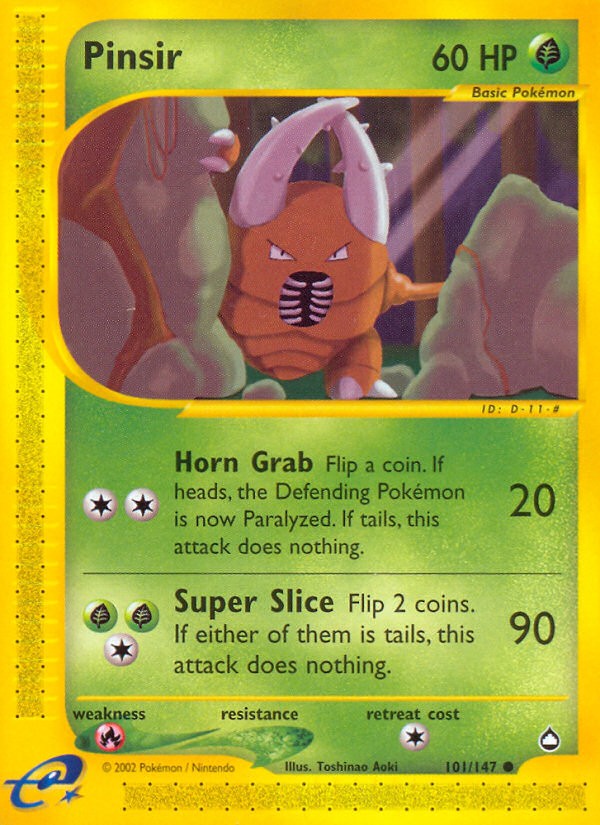
The 2003 Pokémon Aquapolis set features Pinsir as card #101, a Grass-type Basic Pokémon with a distinctive reverse holo finish.
2003 • Pokémon • Aquapolis
No listings available right now.
| Condition | Value | Source | Trend | Price Details |
|---|---|---|---|---|
$38.09 | Guide Estimate | -7.6% | ||
$10.00 | Completed Sales | 0% | ||
$30.00 | Guide Estimate | 0% | ||
$38.00 | Guide Estimate | 0% | ||
$106.24 | Guide Estimate | +68% | ||
$117.00 | Guide Estimate | +67.1% | ||
$579.00 | Guide Estimate | 0% | ||
$105.00 | Guide Estimate | 0% | ||
$445.00 | Guide Estimate | 0% | ||
$267.00 | Guide Estimate | 0% | ||
Raw / Ungraded
PriceCharting Price Guide · Guide Estimate evidence · captured Oct 26, 2026
Released in 2003 as part of the Aquapolis expansion, card number 101 highlights Pinsir as a foundational Grass-type Pokémon within the TCG. This reverse holo variation offers collectors a shimmering alternative to the standard common rarity, appealing to those who appreciate the visual depth that the foil treatment brings to the set. Illustrated by Toshinao Aoki, the card identifies Pinsir as a Basic stage creature with 60 HP, serving as a versatile tool for deck building strategies focused on grass energy acceleration or direct damage. Gameplay mechanics are central to this card's identity. The Horn Grab attack allows players to flip a coin; a heads result paralyzes the defending Pokémon, adding a layer of control to offensive pushes. For those seeking raw power, the Super Slice attack demands two coin flips, dealing 90 damage only if at least one flip lands on heads. This risk-reward dynamic makes Pinsir a memorable inclusion for players navigating the Aquapolis era's tactical landscape. The card's retreat cost of one colorless energy ensures it can move quickly to protect weaker Pokémon or reposition for future attacks. Collecting Aquapolis cards often involves hunting for specific variants like this reverse holo, which stands out against the set's more traditional finishes. Enthusiasts of the early 2000s Pokémon era value these cards not just for their nostalgic connection to the franchise's peak popularity, but for their role in defining competitive and casual play during that time. Completing the Aquapolis set provides a comprehensive look at the Pokémon lineup and mechanics introduced during this pivotal period in trading card history.
We'll pre-fill the product details from this catalog entry, so your listing lands on this exact page. Just add photos of your copy, pick its condition, and set your price.
The catalog profile below summarizes the card identity, featured subject, and notable collectible traits.
The core identity of the card within the set.
The subject, team, league, and sport context tied to this card.
Featured
Pinsir
Game
Pokémon
Rarity, print treatment, and game-specific stats for this card.
Common
Toshinao Aoki
Card Stock
English
Reverse Holo
60
Grass
Basic
Fire ×2
1
127
Abilities, attacks, oracle text, and flavor text printed on the card.
Attack: Horn Grab (20)
Flip a coin. If heads, the Defending Pokémon is now Paralyzed. If tails, this attack does nothing.
Attack: Super Slice (90)
Flip 2 coins. If either of them is tails, this attack does nothing.
FAQ
Pinsir has two attacks: Horn Grab, which deals 20 damage and may paralyze the opponent, and Super Slice, which can deal 90 damage if coin flips result in at least one heads.
The Aquapolis Pinsir card, numbered 101, was illustrated by Toshinao Aoki.
Yes, Pinsir is classified as a Basic Stage Pokémon with 60 HP and Grass energy type in the Aquapolis set.
Explore cards with this name across sets and editions. Check each card’s details before choosing a version.